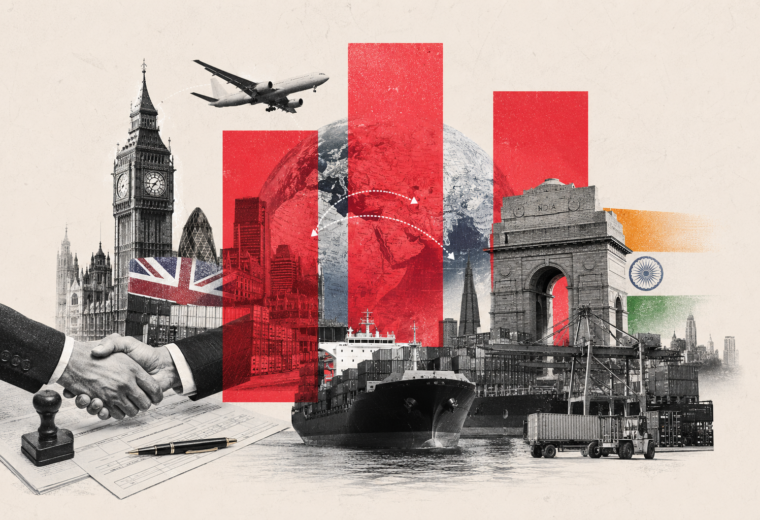
The Indi-UK Free Trade Agreement is more than a tariff-cutting exercise. It is a long-term attempt to reposition Britain and India inside a changing global economy where services, talent, procurement, finance, whisky, textiles and supply chains now carry strategic weight.
The India–UK trade deal is not simply another free trade agreement added to the long archive of diplomatic announcements. It is a structural bet on the next phase of the relationship between London and New Delhi.
From 15 July 2026, businesses in both countries will be able to trade under the terms of the UK–India Free Trade Agreement, after the two governments announced its entry into force in June. The UK government described it as a historic deal that could boost UK GDP by £4.8 billion, real wages by £2.2 billion, and bilateral trade by £25.5 billion every year in the long run. It also said the agreement will be the most comprehensive trade deal India has ever brought into force.
That last phrase matters. India has historically been cautious in trade negotiations. It has often protected sensitive domestic sectors, maintained high tariffs, and avoided the kind of deep market-opening commitments that more liberal economies tend to accept. For Britain, securing a major trade agreement with India after Brexit carries obvious political and economic value. For India, implementing a comprehensive agreement with the UK signals a more confident willingness to use trade policy as a tool of growth, competitiveness and global positioning.
The deal should therefore be understood in three layers. The first is commercial: lower tariffs, easier customs, better market access and wider consumer choice. The second is strategic: Britain wants a deeper role in India’s growth story, while India wants stronger access to premium markets, capital, services and technology. The third is geopolitical: as global trade becomes more fragmented, London and New Delhi are building an economic corridor that is less dependent on older alignments and more responsive to the realities of a multipolar world.
What the deal actually changes
At the most basic level, the India–UK trade deal reduces the cost and complexity of doing business between the two countries. The UK government’s trade campaign says the agreement will make trade “cheaper, quicker and easier,” with lower tariffs, simplified customs, digital processes and clearer rules. It states that the deal liberalises 99% of UK tariffs and 90% of Indian tariffs. For UK exporters, India will remove or reduce tariffs on 90% of tariff lines for UK products, with 64% of products becoming duty-free immediately and 85% becoming duty-free over time. For Indian exporters, the UK will offer duty-free access for 99% of Indian exports from entry into force.
This is the visible part of the agreement. British businesses gain easier access to one of the world’s fastest-growing large economies. Indian exporters gain deeper access to the UK market. Consumers in both countries should see more choice, and some businesses may see cost reductions where tariff cuts are passed through supply chains.
The headline tariff examples show why the deal attracted attention. UK officials said whisky tariffs will be cut from 150% to 40%, automotives from 100% to 10% under a quota, and some cosmetics tariffs of up to 22% will be eliminated either immediately or after staging.
These numbers explain why the agreement is being closely watched by sectors such as alcohol, automotive, cosmetics, textiles, food and consumer goods. A tariff cut is not just a tax change. It can alter price positioning, market entry strategy, distributor economics and brand competition.
For British whisky, the Indian market has long represented both opportunity and frustration: huge demand, rising premium consumption, but extremely high tariff barriers. For Indian fashion, textiles, footwear and food products, duty-free UK access can strengthen competitiveness in a market where price sensitivity and diaspora demand both matter. For automotive companies, quota-based access may create opportunity, but it will still require careful planning because tariffs are only one part of the commercial equation. Regulation, distribution, consumer perception and after-sales support remain critical.
The deeper economic promise
The UK government’s impact assessment provides a clearer picture of the deal’s expected long-term economic effects. It says total trade in goods and services between the UK and India was over £40 billion in 2024, while India’s demand for global imports is estimated to rise to £2.8 trillion by 2050, making it the world’s third-largest importer.
That is the central British rationale. The UK is not negotiating only for current trade flows. It is trying to secure a stronger position in India’s future demand.
The same impact assessment estimates that import duties on UK exports will fall by around £400 million as soon as the agreement comes into force, rising to approximately £900 million after ten years when full staging is complete. It also estimates duties on UK imports from India will fall by £220 million. In the long run, the agreement is expected to increase UK exports to India by nearly 60%, UK imports from India by 25%, and bilateral trade by nearly 39%, equivalent to £25.5 billion a year.
These figures should be read carefully. Trade-model estimates are not guarantees. They depend on business behaviour, exchange rates, global conditions, domestic reforms, infrastructure, political stability and the ability of firms to use the agreement properly. The government itself notes that modelling a deal involving a dynamic economy like India carries uncertainty.
But even with that caution, the direction is clear. Britain wants to attach itself more deeply to India’s import growth, consumer expansion and services market. India wants to use the UK relationship to strengthen export access, investment flows and higher-value sectors.
This is why the agreement is not only about goods. Services are central. The UK campaign page says the agreement includes a pioneering standalone financial services chapter, described as a first for India, and says it locks in long-term market access worth £13.6 billion for UK financial services. It also notes that the UK exported approximately £1.3 billion of business services to India in 2025 and that the deal gives UK businesses equal treatment as domestic firms in India.
For Britain, this matters because services are where the UK is strongest: finance, legal advisory, consulting, education, insurance, fintech, creative industries and professional expertise. For India, this matters because services integration can support capital access, institutional capacity, skills exchange and global-facing business growth.
Procurement, mobility and the quiet architecture of influence
One of the most consequential parts of the agreement may not attract the most public attention: government procurement.
The UK trade campaign says the agreement introduces India’s first comprehensive government procurement chapter in an FTA. It states that UK suppliers will be able to bid for India’s central government procurement contracts for goods and services, a market valued at approximately £38 billion annually. It also says UK firms that source more than 20% of goods or services from the UK can qualify as “Class II suppliers,” making them eligible to participate in Indian government tenders.
This is strategically important. Procurement access is not just about winning contracts. It is about entering the machinery of public infrastructure, technology systems, healthcare, education, transport and state-led development. If British firms can compete credibly in Indian central procurement, the deal could create opportunities far beyond ordinary export sales.
But it will not be automatic. India’s procurement environment is complex, competitive and relationship-driven. British firms will need local understanding, compliance capacity, pricing discipline and patience. The agreement opens the door. It does not walk companies through it.
Mobility is another sensitive layer. The UK government says the deal extends the benefit for UK nationals moving to India to work and continue building entitlement to a UK State Pension from 36 months to 60 months, while they continue paying UK National Insurance and avoid also paying social security contributions in India. It says this is reciprocal for British and Indian professionals and applies to highly skilled professionals on pre-existing visa routes, through the UK–India Double Contributions Convention Agreement entering into force alongside the FTA.
This is politically delicate. In Britain, mobility can quickly become entangled with immigration debate. In India, professional access is closely tied to services exports, skilled labour and global opportunity. The agreement appears designed to support business mobility without creating the perception of uncontrolled migration. That balance will be tested in implementation.
Who benefits first?
The first beneficiaries are likely to be firms already prepared for the agreement. UK officials have told businesses that, to benefit from tariff reductions, they must register with HMRC and prepare origin declarations. The UK campaign page similarly says UK exporters planning to ship originating goods to India should complete one-time HMRC registration through the Origin Registration portal to self-certify origin.
This detail matters more than it sounds. Trade agreements often fail to deliver their full potential because businesses do not understand how to use them. Rules of origin, documentation, customs classification and compliance can determine whether a firm actually receives preferential treatment. Small and medium-sized enterprises may need support more than large corporations, because larger firms already have trade teams, customs advisers and local partners.
The immediate commercial winners could include UK whisky and spirits exporters, cosmetics brands, advanced manufacturers, professional services firms, financial institutions, education providers and technology companies. On the Indian side, textiles, footwear, food products, consumer goods, business services and export-oriented manufacturers could benefit from wider UK access.
But there will also be pressure points. Indian domestic producers may worry about competition from premium British goods. UK producers may face stronger competition from Indian imports in price-sensitive categories. Not every sector gains equally from liberalisation. Trade deals create opportunity, but they also redistribute competitive pressure.
That is why the agreement should be watched not only at the national level, but by region and sector. A deal that looks positive in aggregate can feel very different to a small producer, a logistics firm, a whisky exporter, a textile importer, a fintech company or a professional services provider.
The Prudent assessment
The India–UK trade deal is best understood as a corridor agreement. It does not merely reduce tariffs; it formalises a wider economic route between a mature services-heavy economy and a fast-growing, scale-driven market.
For the UK, the agreement is a test of post-Brexit trade strategy. Britain has claimed that leaving the European Union would allow it to build deeper bilateral trade ties with high-growth economies. India is one of the most important tests of that claim. The deal’s long-term credibility will depend on whether British firms actually export more, invest more, win contracts and deepen services links.
For India, the agreement is a test of selective openness. New Delhi is not abandoning its instinct for strategic protection. But it is showing greater confidence in using trade agreements to expand market access, attract investment, and position Indian firms inside global value chains.
The economic projections are attractive: £25.5 billion in additional bilateral trade in the long run, £4.8 billion in additional UK GDP, and significant duty reductions from day one. But the true measure of the agreement will not be the size of the press release. It will be the number of firms that use it, the quality of investment it attracts, the resilience of supply chains it supports, and the seriousness with which both governments remove practical barriers.
The deal gives London and New Delhi a stronger framework. It does not remove the hard work. Businesses must register, comply, adapt and compete. Governments must keep systems clear, customs efficient and political trust intact.
The intelligent conclusion is cautious optimism. The India–UK trade deal has the scale to matter, the timing to be strategic, and the sectoral reach to reshape more than goods trade. But like every serious agreement, it will only become powerful through execution.
The corridor is open. The question now is who is prepared to move through it.