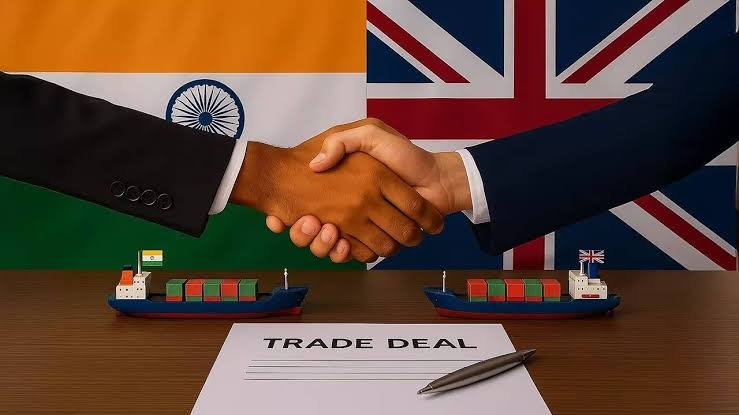
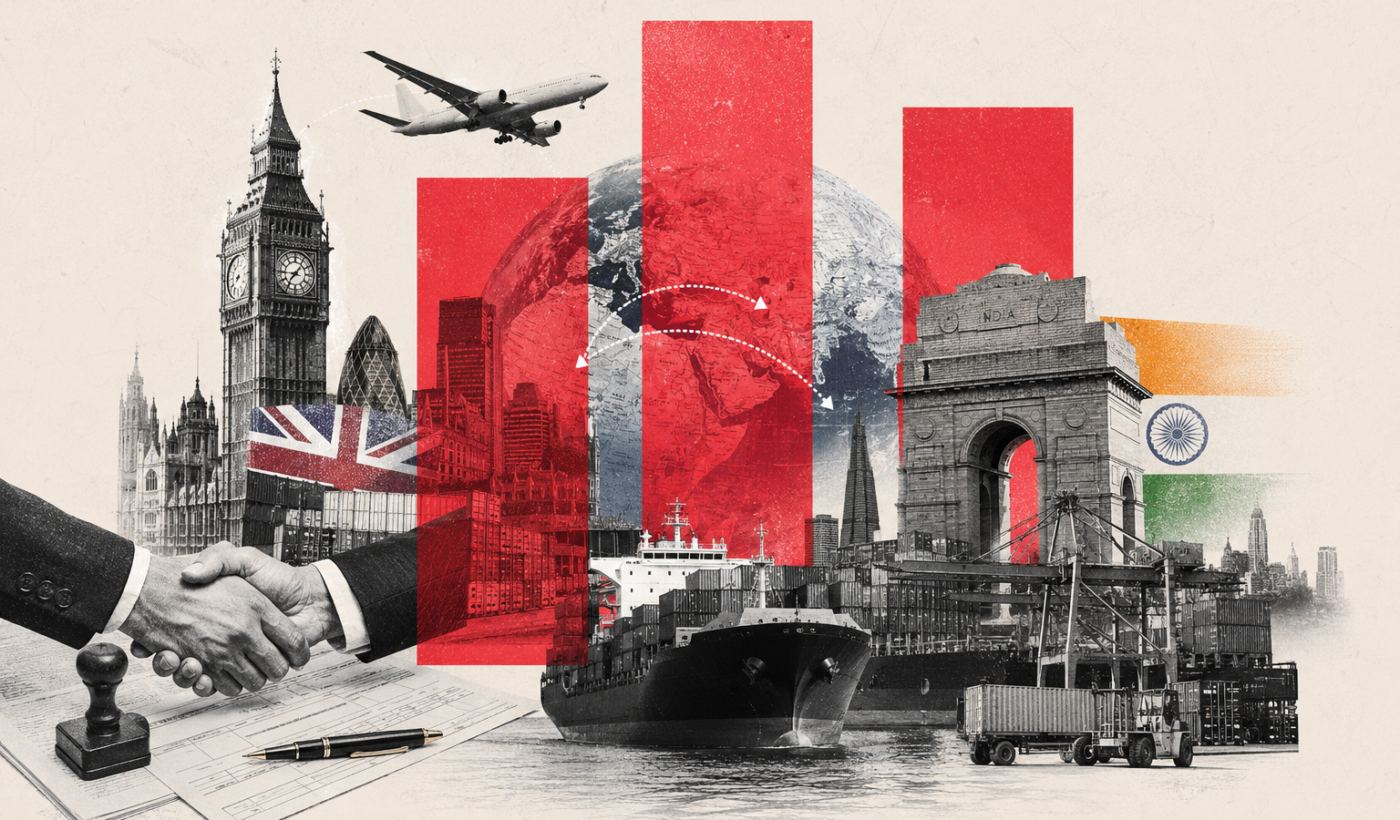
The agreement creates a new economic corridor between London and New Delhi, but its real value will depend on rules of origin, customs readiness, business awareness, regulatory clarity and whether companies on both sides can actually use the deal.
The India–UK trade deal has already passed through the easy part of public attention. It has produced the announcement, the diplomatic language, the headline numbers and the symbolic image of two major economies choosing closer commercial alignment.
Now comes the harder test: execution.
From 15 July 2026, businesses in Britain and India will be able to trade under the terms of the UK–India Free Trade Agreement. The UK government says the deal could increase UK GDP by £4.8 billion, raise real wages by £2.2 billion, and increase bilateral trade by £25.5 billion every year in the long run. It has also described the agreement as the most comprehensive trade deal India has ever agreed.
Those numbers matter. But they are not the same as delivery.
A trade agreement is not a machine that starts automatically on the day it enters into force. It is a framework. Its benefits depend on whether exporters understand the rules, whether importers can prove origin, whether customs systems recognise the correct documentation, whether small businesses know how to claim preferences, and whether both governments keep the implementation process clear enough for firms to trust it.
That is why the serious question is no longer whether the India–UK trade deal is important. It is. The more useful question is whether the deal can move from treaty text into everyday commercial behaviour.
What changes on paper
On paper, the agreement is significant. The UK government’s trade campaign says the deal will make trade between the two countries cheaper, quicker and easier through lower tariffs, streamlined customs processes and better market access. It states that the agreement liberalises 99% of UK tariffs and 90% of Indian tariffs. It also says 64% of UK products exported to India will become duty-free immediately, rising to 85% over time, while 99% of Indian exports to the UK will receive duty-free access from entry into force.
The most visible gains sit in goods. British whisky exporters have long faced high Indian tariffs. UK officials say whisky tariffs will be cut from 150% to 40%, while automotive tariffs will fall from 100% to 10% under a quota. Certain cosmetics tariffs of up to 22% will also be eliminated either immediately or after staging.
For India, the duty-free access to the UK market is commercially powerful. Textiles, apparel, food products, footwear, engineering goods and consumer categories all stand to gain if firms can move quickly. For Britain, the appeal is not only goods access but the chance to deepen services, finance, professional, technology and education links with one of the world’s largest growth markets.
The government’s impact assessment says total UK–India trade in goods and services was over £40 billion in 2024, while India’s demand for global imports is projected to reach £2.8 trillion by 2050. It also estimates that import duties on UK exports will fall by around £400 million when the FTA comes into force, rising to about £900 million after ten years once full staging is complete.
This is why the agreement has attracted attention. It is not a minor technical arrangement. It connects a services-heavy British economy with a scale-driven Indian market whose consumption, manufacturing, infrastructure and technology needs are still expanding.
But the first implementation lesson is simple: access is not the same as utilisation.
A tariff can fall on paper while companies fail to claim the preference. A market can open in principle while exporters lack local distribution. A customs process can be simplified in law but remain confusing in practice. A trade agreement can be good policy and still produce disappointing outcomes if businesses are not ready.
Rules of origin are the first real test
The most important phrase in the first months of the agreement may not be “tariff cut.” It may be rules of origin.
Rules of origin decide whether a product actually qualifies for preferential treatment under a trade agreement. They answer a basic but difficult question: is this product genuinely British or Indian enough to receive the lower tariff?
In modern trade, that question is rarely simple. A bottle, garment, machine part, cosmetic product or food item may involve inputs from several countries. A product might be designed in one country, assembled in another, packaged in a third, and shipped through a fourth. Without clear origin rules, tariff preferences can be abused or misunderstood.
The UK’s business guidance is explicit that qualifying for lower tariffs depends on meeting the agreement’s rules of origin. It also notes that goods transiting through a non-party must remain under customs control and must not undergo further processing outside the UK or India, except for permitted operations.
This detail matters because the India–UK corridor will not operate in isolation. Many firms use global logistics networks. Goods may move through the Gulf, Europe or Southeast Asia before reaching their final destination. If paperwork, transit control or origin documentation is wrong, the commercial advantage of the FTA can disappear at the border.
The UK government has also issued guidance telling UK producers and exporters to register with HMRC if they plan to complete origin declarations for goods exported to India under the agreement. The guidance explains that the agreement allows exporters to self-certify origin instead of obtaining a certificate from a competent authority for every consignment.
Self-certification sounds like simplification, and it is. But it also places responsibility on the exporter.
A firm cannot merely say its goods qualify. It must understand the rule, keep evidence, issue the correct declaration and be prepared for checks. Larger exporters may have customs teams. Smaller companies may not. This is where implementation could become uneven. The businesses with advisers, compliance systems and export experience may move quickly. Smaller firms may discover too late that the deal is useful only if they can navigate the documentation.
For The Prudent UK, this is the first serious implementation risk. The agreement’s headline benefits will be captured fastest by prepared firms, not necessarily by the firms that need them most.
Customs readiness and business awareness
The second test is administrative readiness.
The UK government said businesses had 28 days to prepare after the entry-into-force date was announced, following efforts to prepare British and Indian systems. That is not a long period for companies that need to examine product classifications, supply chains, distributor contracts, origin rules, pricing models and customs documentation.
Trade agreements reward preparation. A whisky exporter needs to understand staging, tariffs, labelling, Indian distribution and state-level alcohol rules. A textile exporter needs to understand UK buyer requirements, documentation, sustainability expectations and delivery reliability. A services provider needs to understand whether market access actually translates into local permission, procurement eligibility or practical client acquisition.
The House of Commons Library’s briefing notes that the UK exported £19 billion of goods and services to India in the year to September 2025, while imports from India were £28 billion. It also notes that the agreement was signed in 2025 and will enter into force on 15 July 2026. These trade flows are already large enough to matter, but the ambition is to deepen them substantially.
The challenge is that many companies will still think of the deal as a political event rather than an operational change. That is a mistake.
The firms that benefit early will be those that ask practical questions now. Which products qualify? Which HS codes apply? What documents are required? Is the supplier origin evidence strong enough? What happens if goods transit through a third country? Does the importer know how to claim the preference? Do contracts need updating? Is pricing being revised? Are customs brokers prepared?
This is especially important for small and medium-sized businesses. Large companies can absorb complexity. SMEs often cannot. If government wants the deal to support broader growth rather than only established exporters, it must invest heavily in guidance, webinars, sector-specific explainers, customs support and regional business outreach.
Otherwise, the deal may become another agreement whose benefits are real but concentrated.
The services question remains difficult
The India–UK trade deal is also about services, but services are harder than tariffs.
Goods trade can be measured through customs codes and duties. Services trade depends on regulation, qualifications, licensing, market trust, data flows, local presence, immigration rules and procurement systems. A tariff can be cut overnight. A professional services market can take years to open meaningfully.
The UK government’s campaign highlights a standalone financial services chapter and says the deal locks in long-term market access for UK financial services. It also points to opportunities in business services, legal services and procurement. But even where formal commitments exist, firms must still translate them into commercial relationships.
This is where the deal’s implementation will be judged less by the treaty and more by the behaviour of regulators, agencies, buyers and professional bodies.
Can British financial firms expand in India without facing informal barriers? Can Indian services firms use the UK market more efficiently? Will qualifications be recognised in practice? Will procurement opportunities be transparent enough? Will digital processes make cross-border work easier? Will business mobility arrangements be predictable?
The services layer is strategically important because the UK economy is structurally strong in services. Finance, law, consulting, higher education, insurance, creative industries, digital services and professional advice are central to Britain’s export model. If the deal delivers mostly in goods, it will still be useful. If it delivers in services as well, it becomes more powerful.
But that requires patience. Services liberalisation is rarely dramatic on day one. It happens through trust, regulatory familiarity and repeated commercial use.
The Prudent assessment
The India–UK trade deal is signed. The corridor is open. But a corridor is only valuable if people, goods, services and capital can move through it smoothly.
The next phase will be less glamorous than the announcement but far more important. It will be built in customs forms, origin declarations, shipping documents, procurement notices, HMRC registrations, Indian market-entry plans, distributor negotiations and compliance checks.
The deal’s promise is substantial. It can reduce duties, expand access, strengthen the UK’s position in India’s long-term growth, and give Indian exporters a stronger route into Britain. It can support premium British exports, Indian manufacturing, professional services, financial links and a wider strategic relationship between London and New Delhi.
But the risk is equally clear. If businesses do not understand the rules, if guidance is too thin, if customs systems become inconsistent, if SMEs are left behind, or if services commitments remain more formal than practical, the agreement will underperform.
The first test of the India–UK trade deal is therefore not diplomatic success. That has already been achieved. The first test is administrative competence.
A serious trade agreement does not end with signature. It begins there. The coming months will show whether Britain and India have built not merely a political agreement, but a usable economic system.
For exporters, the instruction is direct: prepare the paperwork before expecting the preference. For policymakers, the obligation is equally direct: keep the system clear, predictable and commercially intelligible.
The India–UK trade deal has opened a door. Implementation will decide how many businesses can actually walk through it.