The energy crisis is no longer at its 2022 peak, but the July 2026 price-cap rise shows why household energy remains one of Britain’s most sensitive political risks before winter.
The British energy crisis has changed shape, but it has not disappeared.
For many households, the worst period of panic may feel like it belongs to an earlier phase: the extraordinary bill shock after Russia’s full-scale invasion of Ukraine, the emergency government interventions, the fear around direct debits, and the political pressure that surrounded every price-cap announcement. But the summer of 2026 has shown that energy remains one of the most dangerous domestic issues in British politics.
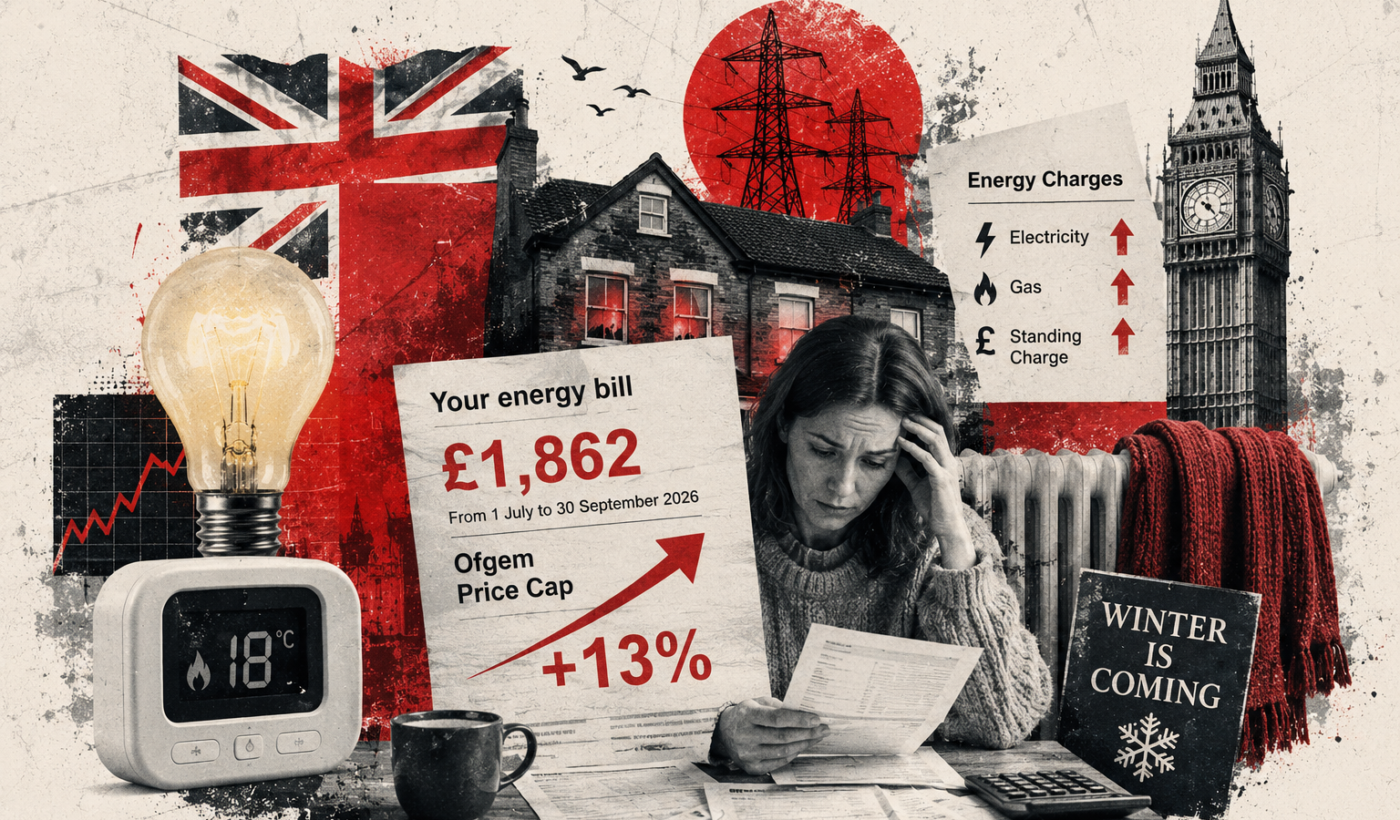
From 1 July to 30 September 2026, Ofgem’s energy price cap rose to £1,862 a year for a typical dual-fuel household paying by direct debit. That is a 13% increase from the previous cap period. Ofgem is clear that the cap is not a fixed bill; it limits the unit rates and standing charges suppliers can apply to customers on standard variable tariffs, meaning actual bills still depend on how much energy a household uses.
That distinction matters, but it does not reduce the political effect. Most people do not experience energy policy through technical formulas. They experience it through monthly payments, cold rooms, hot water decisions, meter readings, standing charges and the uneasy feeling that household budgeting is again becoming less predictable.
The issue is no longer whether Britain can survive an emergency price shock. It has already done that. The issue now is whether the country can build a system where energy is affordable, stable and trusted before every winter turns into a fresh political test.
The price cap is rising again
The July price-cap increase is the first reason energy has returned to the political foreground.
Ofgem announced that energy prices would rise by 13% for a typical household using electricity and gas and paying by direct debit. The new cap of £1,862 covers the July to September period, and it follows a lower April to June cap of £1,641.
The House of Commons Library explains why the change is especially uncomfortable. It says wholesale gas prices doubled in early March 2026 in response to the start of conflict in the Middle East. Although prices later fell back from those highs, they remained volatile and above much of their 2025 level. The Library also notes that this earlier wholesale increase feeds through to the price cap from July, with gas and electricity unit prices increasing by 28% and 6% respectively.
That is the central household problem. Energy costs do not only respond to domestic policy. They are tied to global gas markets, geopolitical shocks, exchange rates, supply risk and weather patterns. A household in Manchester, Birmingham or Bristol may not follow the detail of conflict risk in the Gulf, but its energy bill can still carry the consequences months later.
The price cap creates some protection by preventing suppliers from charging above regulated unit rates and standing charges on default tariffs. But it does not insulate consumers from the underlying volatility of wholesale energy markets. The cap moves. It changes quarterly. It can fall when costs fall, and rise when input costs rise.
For ministers, this creates a recurring political difficulty. Every price-cap update becomes a public verdict on the state’s ability to protect households. If the cap rises before winter, the opposition can argue that the government has failed to control living costs. If it falls, the relief may still feel modest because bills remain far above the pre-crisis normal for many households.
Energy politics therefore operates through memory as much as through data. People remember lower bills. They compare today’s direct debit not only with last quarter, but with life before the energy crisis. That is why even a regulated system can feel unstable.
Standing charges have become a trust issue
Energy bills are politically sensitive not only because of unit prices, but because of standing charges.
Standing charges are daily fixed fees paid regardless of how much energy a household uses. They cover costs such as network maintenance and supplier obligations. Ofgem explains that the price cap includes both unit rates and standing charges, and that the standing charge is part of what consumers pay even before usage is counted.
This is one reason public frustration has grown. A household can reduce usage, turn down heating, avoid appliances, and still face a bill because part of the cost is fixed. For low users, pensioners, single-person households and people who have already cut consumption heavily, standing charges can feel like a penalty for being connected to the system.
That perception is politically dangerous. Energy policy depends on public confidence. If households believe the system is unfair, technical explanations about network costs will not be enough. Fairness is not only about average bills. It is about whether people feel they have control.
Recent supplier trials with lower standing charges show that the issue has become commercially and politically visible. EDF and E.ON have launched or trialled tariffs designed to reduce fixed charges for selected customers, although such arrangements can involve higher unit rates and may not benefit every household.
The wider question is how Britain should divide energy-system costs. If too much is placed on standing charges, low users feel exposed. If too much is placed on unit rates, high users and families in poorly insulated homes may suffer. If costs are shifted into general taxation, the Treasury must carry more of the burden. None of these choices is painless.
This is why energy bills are now a distributional issue. They raise difficult questions about who pays for the grid, who pays for legacy policy costs, who pays for bad debt, and how much should be socialised across all users. Before winter, those questions become sharper because energy is not optional.
Winter support is becoming more targeted
The third political test is support.
During the height of the energy crisis, government support was broad. That was expensive, but politically clear. By 2026, the support environment is more targeted and more complicated.
The Warm Home Discount remains a one-off £150 discount on electricity bills for eligible households. GOV.UK says the scheme has closed for winter 2025 to 2026 and will reopen in October 2026. The money is not paid directly to households; it is applied by the electricity supplier if the household is eligible.
The Winter Fuel Payment is also politically sensitive. GOV.UK says most eligible people will be paid in November or December 2026, while people whose total income is over £35,000 will have the payment recovered by HMRC.
Targeting support is fiscally understandable. Universal support is costly, and the Treasury faces pressure across public services, debt interest, health, welfare and infrastructure. But targeting creates its own problems. People just above thresholds may feel unfairly excluded. Households with high medical energy needs may not fit neat income categories. Older people with moderate incomes but high housing or care costs may still feel vulnerable.
The politics of energy support is therefore not only about generosity. It is about design. A badly designed scheme can create resentment even if it spends large sums. A well-designed scheme must reach vulnerable households, remain simple enough to understand, and avoid leaving people in administrative uncertainty at exactly the time bills rise.
Winter is unforgiving in that respect. If support arrives late, is poorly communicated, or depends on systems people cannot navigate, political blame follows quickly.
Off-grid and rural households remain exposed
The price-cap debate often focuses on gas and electricity customers in Great Britain. But Britain’s energy vulnerability is not uniform.
Northern Ireland is not covered by the Great Britain energy price cap, and the House of Commons Library notes that only a minority of households there use mains gas for heating. Rural and off-grid households elsewhere can also be exposed to heating oil or LPG markets that are not covered by the Ofgem domestic gas and electricity price cap.
This matters because political narratives around “the average bill” can miss households whose energy lives are structurally different. A rural family using heating oil does not experience energy support in the same way as an urban household on mains gas. A household in a poorly insulated old home faces a different cost profile from a flat in a newer building. A person on a prepayment meter experiences risk differently from someone paying by direct debit.
The Guardian reported earlier this year that households dependent on heating oil faced sharp price increases linked to conflict-related market volatility, and noted that heating oil is not regulated by Ofgem’s energy price cap.
These differences matter politically because they expose the limits of national averages. The “typical household” cap is useful for communication, but it cannot describe every household’s vulnerability. Energy policy that relies too heavily on averages risks missing the places where hardship is most acute.
The deeper problem is Britain’s energy structure
The immediate political debate is about bills. The deeper issue is Britain’s energy structure.
The UK remains exposed to gas-price volatility because gas still influences electricity prices and heating costs. Even as renewables expand, households can still feel the effect of international gas-market movements. The House of Commons Library’s account of wholesale gas prices doubling in early March 2026 is a reminder that energy security is not abstract. It is transmitted into the domestic economy through bills.
This creates a difficult contradiction. The long-term solution to volatile fossil-fuel prices is a cleaner, more efficient and more resilient energy system. That means insulation, electrification, grid investment, renewable generation, storage, flexibility and lower dependence on imported gas. But building that system costs money, and some of those costs appear on bills before households feel the full benefit.
That is why energy transition is politically fragile. Voters may support cleaner energy in principle, but they resist policies that appear to raise costs in the short term. If the government cannot explain how investment today reduces exposure tomorrow, the energy transition becomes easy to attack.
This is where seriousness is needed. Britain cannot promise permanently low bills while remaining exposed to volatile global energy markets. It also cannot demand public patience indefinitely while household budgets are strained. The state must show a visible pathway from today’s pain to tomorrow’s stability.
That means improving home efficiency at scale, especially for low-income and poorly insulated households. It means reforming how electricity prices are shaped by gas. It means protecting vulnerable people without making support so complex that people miss it. It means being honest that energy security, affordability and decarbonisation are connected, not separate.
The Prudent assessment
Energy bills remain a political test because they sit at the point where global risk enters domestic life.
A gas price spike can begin in a distant conflict, pass through wholesale markets, move into the Ofgem cap, change a household direct debit, and become a political argument at the doorstep. That chain is difficult for governments to control, but voters will still judge them by the outcome.
The July 2026 price-cap rise has made the issue visible again. The cap is lower than the most traumatic moments of the energy crisis, but high enough to remind households that the system remains exposed. Unit prices are rising, standing charges remain contested, winter support is targeted, and off-grid households face vulnerabilities that the national average does not capture.
The political risk before winter is therefore clear. If temperatures fall, bills rise again, and support feels inadequate or confusing, energy will return as one of Britain’s most powerful cost-of-living issues.
The intelligent policy response is not to pretend that government can control every global price movement. It cannot. The serious response is to reduce exposure over time and protect the most vulnerable during the transition.
Britain needs an energy settlement that feels fair, predictable and credible. Until it has one, every winter will test not only household budgets, but the public’s confidence in the state’s ability to manage the basics.