Public borrowing sounds like a Treasury issue, but the May 2026 figures show why debt interest, inflation and weak fiscal space are now directly connected to NHS pressure, council strain, infrastructure delays and the quality of everyday public services.
Public borrowing is often treated as an argument for economists, Treasury officials and Westminster spending rounds. It appears in billions. It is measured against GDP. It is debated through forecasts, fiscal rules and bond-market signals. For many households, it can feel distant from ordinary life.
That distance is disappearing.
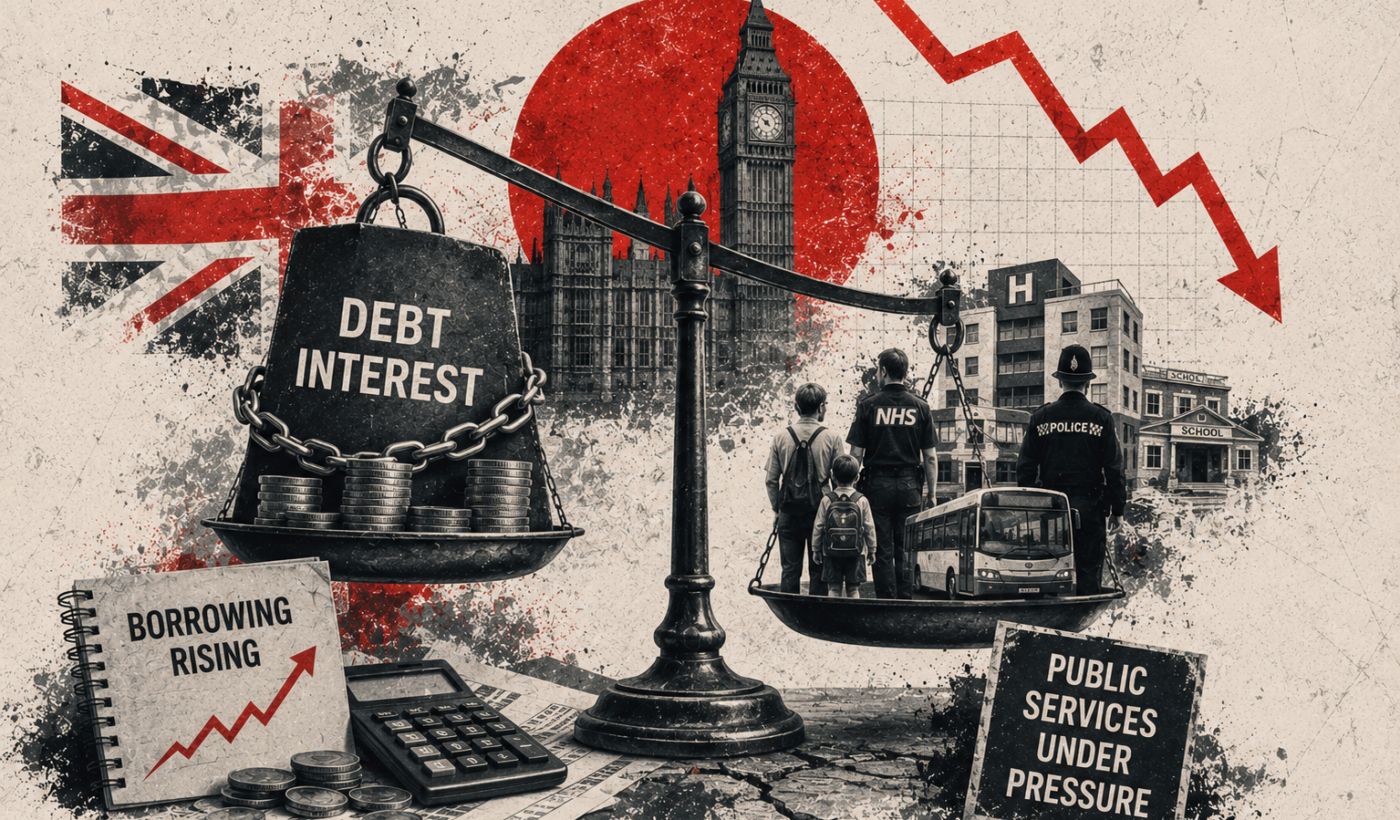
Britain’s borrowing problem is becoming a public services problem because debt interest now competes directly with the money needed for hospitals, schools, councils, transport, courts, defence, housing and infrastructure. When the state spends more to service debt, it has less room to improve services without raising taxes, cutting elsewhere or borrowing again. The choice may sound technical, but the result is visible: longer waits, thinner local services, delayed projects and permanent pressure on public-sector capacity.
The latest public finance figures underline the point. The Office for National Statistics said public sector borrowing was £23.3 billion in May 2026, £5.4 billion more than in May 2025 and the second-highest May borrowing on record. Central government debt interest payable was £11.7 billion in the same month, £4.1 billion higher than a year earlier and the highest May figure on record, not adjusted for inflation. Public sector net debt stood at 95.1% of GDP at the end of May 2026, a level last seen in the early 1960s.
Those figures are not only a balance-sheet warning. They are a service-delivery warning.
A state can borrow to invest, respond to crisis or smooth economic shocks. But when borrowing rises simply to fund current pressures, and when debt interest absorbs more of the public pound, the country begins to face a harder question: how much of the state’s income is available for the services people actually use?
The debt-interest bill is now a public-service issue
Debt interest is often invisible in political debate because it does not open a hospital ward, fill a pothole or hire a teacher. It is money paid to service past borrowing. But it is still public spending, and it has to be financed like any other spending.
That is why the May figure matters. The ONS said central government debt interest payable reached £11.7 billion in May 2026. It also explained that recent movements in the Retail Prices Index added volatility to monthly debt interest costs, with index-linked gilts increasing the interest payable.
This is not an accounting footnote. It is the mechanism through which inflation becomes a fiscal problem. When parts of the government’s debt stock are linked to inflation, higher RPI can increase the accrued cost of servicing that debt. The public may experience inflation through food, rent, energy or mortgage pressure. The Treasury experiences it through welfare uprating, pension costs, public-sector pay pressure and debt interest.
That combination narrows political room.
The state still has to fund the NHS. It still has to finance schools. It still has to support defence, prisons, courts, local government, transport networks and social care. But when debt interest rises, it becomes one of the largest claims on public money before ministers even begin choosing new priorities.
This is why the borrowing problem is no longer abstract. Every pound spent servicing debt is a pound that cannot be spent twice. It may be necessary. It may be unavoidable. But it is not neutral.
A government with low debt-interest costs can make choices with more freedom. It can absorb economic surprises, increase investment, repair services or reduce taxes with less immediate pressure. A government with high debt-interest costs enters every spending decision with less margin. Even if it wants to rebuild public services, it must first satisfy the arithmetic of the debt stock.
That is the fiscal squeeze now facing Britain.
Borrowing is running ahead of forecast
A single month does not define the public finances. But May’s figures are important because they show borrowing running ahead of expectations.
The ONS said borrowing in May 2026 was £5.6 billion more than the £17.7 billion forecast by the Office for Budget Responsibility. Borrowing in the financial year to May 2026 reached £46.3 billion, £8.9 billion more than the same period a year earlier and £7.7 billion above the OBR forecast profile.
That matters because fiscal plans are built on forecasts. Spending settlements, tax plans, borrowing assumptions and debt targets all depend on whether the economy and public finances behave broadly as expected. When borrowing comes in higher than forecast, the government does not automatically face crisis. But it does lose space.
There are only a few ways to respond. Ministers can hope the data improve later in the year. They can raise taxes. They can cut spending. They can borrow more. They can delay investment. Or they can look for productivity improvements inside public services.
None of those choices is politically easy.
The OBR’s March 2026 forecast expected public sector net borrowing to fall from 5.2% of GDP in 2024–25 to 4.3% of GDP this year, and then to 1.6% of GDP in 2030–31. It also expected public sector net debt to be broadly stable and settle around 95% of GDP in the early 2030s.
That is not a comfortable baseline. It is a narrow path. It assumes that borrowing declines, debt stabilises and growth, receipts and spending remain close enough to forecast. If borrowing repeatedly overshoots, the path becomes harder.
This is the difference between a fiscal plan and fiscal comfort. Britain may have a plan. It does not yet have comfort.
Public services are already under visible strain
The borrowing problem would be easier to manage if public services were already strong. They are not.
The NHS remains the most visible example. The British Medical Association’s June 2026 backlog analysis said the waiting list increased to 7.28 million cases, representing around 6.16 million individual patients waiting for treatment. It also said around 2.51 million patients had been waiting over 18 weeks, while approximately 105,000 had been waiting over a year.
Those numbers are not simply a health statistic. They are a fiscal warning.
When services are under pressure, governments cannot easily reduce spending without visible consequences. If hospital backlogs are high, cutting health funding is politically and socially difficult. If councils are struggling, reducing local government support affects care, libraries, children’s services, waste collection, roads and neighbourhood services. If courts are delayed, justice slows. If prisons are full, public safety and legal capacity become strained. If infrastructure is delayed, future growth weakens.
This is where public debt and public services meet.
A country can sometimes consolidate its finances quietly if services are functioning well and the economy is growing strongly. Britain’s problem is that fiscal pressure is arriving at the same time as service pressure. That means every spending decision has a public face.
Debt interest is invisible. A cancelled bus route is not. A long NHS wait is not. A closed library is not. A delayed school repair is not. A council tax rise is not. A road full of potholes is not.
The political challenge is therefore brutal. Voters may accept the need for fiscal discipline in theory, but they experience the consequences through services. They do not live inside OBR charts. They live inside local systems.
Councils show the front line of fiscal stress
Local government is where national fiscal pressure becomes local reality.
Councils are responsible for many services that shape everyday life: adult social care, children’s services, homelessness support, planning, local roads, waste, parks, libraries, public health and community infrastructure. When council finances weaken, the public notices quickly.
Parliament’s Housing, Communities and Local Government Committee has examined financial distress in local authorities, noting that since 2018 eight English local authorities have issued section 114 notices and that the consequences can be significant for local service delivery and local democracy. It also said various sources continue to report that other authorities are financially unsustainable and at risk of issuing such notices.
A section 114 notice is often described as a council’s effective bankruptcy warning, although local authorities cannot go bankrupt in the normal corporate sense. The practical meaning is severe: spending controls tighten, non-essential expenditure is restricted, and councils must confront the gap between their obligations and available resources.
This matters because local government carries demand that cannot simply be wished away. Adult social care grows with an ageing population. Children’s services are expensive and legally sensitive. Homelessness is costly. Special educational needs provision is under pressure. Local infrastructure requires maintenance even when budgets are tight.
When central government is fiscally constrained, councils often feel that constraint through funding settlements, grants, council tax pressure and limited capital flexibility. Residents then experience national fiscal pressure as local decline.
This is one reason Britain’s borrowing problem is not only a Treasury story. It is a civic story. The state’s balance sheet is now connected to the condition of neighbourhood services.
Spending plans leave limited room for error
The 2025 Spending Review set departmental budgets for day-to-day spending until 2028–29 and capital investment until 2029–30, with total departmental budgets growing by 2.3% across the Spending Review period.
That sounds like growth. But spending growth does not automatically mean relief.
If demand rises faster than budgets, services remain under pressure. If inflation raises delivery costs, real capacity may not improve as much as headline figures suggest. If workforce shortages persist, money may not translate quickly into better performance. If capital projects become more expensive, infrastructure investment buys less. If debt interest rises unexpectedly, future spending rounds become more constrained.
The OBR’s March forecast also noted that total public spending as a share of GDP is expected to remain above pre-pandemic levels, while the later years of the forecast involve departmental spending falling as a share of GDP after 2027–28.
That is the tension. The public wants better services. Departments face rising demand. Debt remains high. Borrowing must fall if fiscal targets are to be met. Taxes are already politically sensitive. The economy is not growing fast enough to make the problem painless.
In that environment, spending plans can look adequate on paper while feeling inadequate in reality.
This is especially true for services where demand is structural rather than temporary. Health, social care, special educational needs, defence, prisons and housing are not short-term pressures. They are long-term claims on the state. If borrowing remains high and debt interest absorbs more money, these services compete within a tighter envelope.
The hidden cost is delayed investment
Borrowing debates often focus on day-to-day spending, but Britain’s deeper danger may be delayed investment.
The UK needs infrastructure: energy networks, hospitals, schools, transport links, flood defences, defence capability, housing, digital systems and local regeneration. Some borrowing for productive investment can be justified if it raises future growth, resilience or service quality. The problem is that high debt and high debt interest make even good investment harder to finance politically.
When fiscal space is tight, capital projects become tempting to delay. They are often less immediately visible than current spending. A postponed transport upgrade or hospital rebuild may create less instant political pain than cutting an existing service. But delay has a cost. Infrastructure becomes more expensive to repair later. Economic capacity suffers. Public services operate from outdated buildings and systems. Productivity improvements are lost.
This is how a borrowing problem can become a growth problem.
If the state cuts investment to satisfy short-term fiscal pressure, it may weaken the very growth needed to improve the public finances. If it borrows heavily without discipline, it may increase debt-interest costs and reduce future flexibility. The challenge is not simply to spend less or borrow more. It is to distinguish between borrowing that finances current pressure and borrowing that builds future capacity.
Britain’s fiscal debate often fails because it treats borrowing as either virtue or sin. The more serious distinction is between productive borrowing and defensive borrowing.
Productive borrowing builds assets, capacity and future revenue. Defensive borrowing plugs gaps, absorbs shocks or postpones decisions. Britain needs more of the first and less dependence on the second.
The Prudent assessment
Britain’s borrowing problem is no longer abstract because the trade-off is now visible.
The country is carrying debt at levels last seen in the early 1960s. Borrowing is running above forecast. Debt interest is volatile and expensive. Public services are under strain. Councils are financially exposed. The NHS backlog remains large. Infrastructure needs are urgent. Spending plans leave limited margin for error.
This is not an argument for panic. Britain remains a major advanced economy with deep capital markets, strong institutions and the ability to finance itself. But confidence should not become complacency.
The state is entering a period in which fiscal discipline and public-service repair must happen at the same time. That is difficult because each objective can weaken the other if handled badly. Cut too quickly, and services deteriorate. Borrow too freely, and debt interest absorbs more space. Raise taxes without growth, and households and businesses feel punished. Delay investment, and future growth weakens.
The intelligent answer is not a slogan. It is a strategy.
Britain needs to reduce wasteful current pressure, protect productive investment, reform services where delivery is failing, and be honest with the public that high debt interest has real consequences. It also needs growth, because without stronger growth the argument becomes a permanent fight over scarcity.
The May 2026 borrowing figures are therefore more than a fiscal data release. They are a warning about state capacity.
A government can borrow money. It cannot borrow trust indefinitely. If citizens keep seeing higher taxes, higher debt and weaker services, the public will eventually ask not only where the money went, but whether the state still knows how to turn money into results.
That is the real danger. Britain’s borrowing problem is becoming a public services problem because the balance sheet and the street are now connected. The figures may begin in Whitehall, but the consequences are felt in hospitals, council offices, classrooms, courts, buses, roads and homes.