
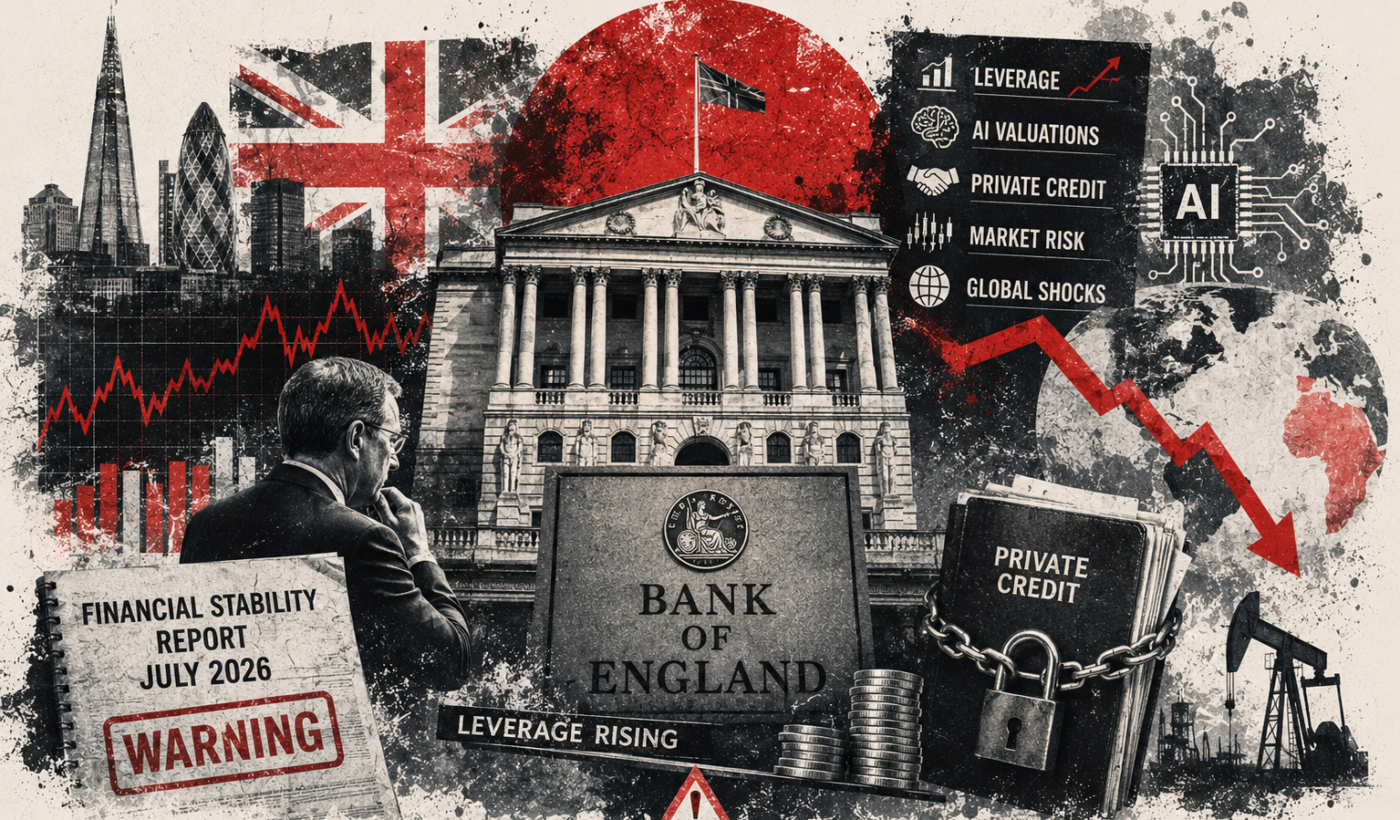
The Bank of England’s July 2026 financial-stability warning is not a panic signal. It is more serious than that: a reminder that Britain’s financial risks now sit in markets, leverage, private credit, AI exposure and global shocks that can move faster than ordinary households realise.
The Bank of England is not saying Britain is heading for a financial crisis.
That is important. The language of financial stability is often misunderstood because it sits between reassurance and warning. When the Bank says the UK financial system remains resilient, it does not mean risk has vanished. It means the system is judged capable of absorbing shocks without immediately breaking.
But resilience is not the same as safety.
The Bank’s July 2026 financial-stability assessment should be read carefully by anyone trying to understand the UK economy beyond the usual interest-rate headlines. The Financial Policy Committee said vulnerabilities in risky asset valuations, sovereign debt markets and risky credit markets remain, including in private credit, and that some have become more pronounced since the December 2025 Financial Stability Report. It also noted a substantial increase in the use of leverage in equity markets.
That is the real message. The risk is not only in high-street banks. It is not only in mortgages. It is not only in household debt. The risk is increasingly in the machinery around the financial system: hedge funds, private credit, leveraged exchange-traded funds, AI-linked valuations, bond-market pressure, cyber resilience and the way non-bank finance can transmit stress.
For UK readers, this may sound remote. It is not. When financial markets become unstable, the effects eventually move into ordinary life: pension values, mortgage rates, business borrowing, government debt costs, tax pressure, investment decisions and the availability of credit.
A financial system can appear calm until several risks begin moving together. That is why the Bank’s warning matters.
The risk is no longer one single shock
The Bank’s central concern is not that one event will automatically break the system. It is that several vulnerabilities could crystallise at the same time.
The July Financial Policy Committee record says developments in the Middle East have materially affected the global risk environment. It notes that the conflict produced a substantial negative supply shock to the global economy, triggered significant market reactions, increased volatility in energy and commodity prices, and pushed market interest rates higher globally, including in the UK.
That kind of shock matters because Britain is not financially isolated. Global oil prices affect inflation. Inflation expectations affect interest rates. Interest rates affect government borrowing costs, mortgage pricing, corporate funding and asset values. A geopolitical event can move from a battlefield into a household budget through financial markets before most people fully understand the chain.
The Bank also noted that the signing of a Memorandum of Understanding between the US and Iran reduced near-term risks and helped energy prices fall back to just above pre-conflict levels. But it added that substantial uncertainty remains and that energy prices and interest-rate markets have stayed volatile.
That distinction is crucial. A risk can ease without disappearing. Markets may calm after a diplomatic development, but the underlying exposure remains. If energy prices rise again, inflation could become more difficult. If bond yields rise, government financing becomes more expensive. If equities fall sharply, leveraged investors may be forced to sell assets quickly.
This is why the Bank’s language is careful. It is not predicting collapse. It is warning that the system contains amplification channels.
In simple terms, amplification means a shock becomes larger as it moves through the system. A fall in asset prices can trigger forced selling. Forced selling can push prices lower. Lower prices can create margin calls. Margin calls can force more selling. What begins as a market adjustment can become a disorderly move.
That is the kind of risk regulators worry about most, because it often appears manageable until it suddenly accelerates.
Leverage is the quiet danger
The most important word in the Bank’s warning is leverage.
Leverage means using borrowed money or financial structures to increase exposure. It can increase returns when markets rise. It can also increase losses when markets fall. In calm periods, leverage often looks efficient. In stress, it becomes a pressure point.
The Financial Policy Committee said there has been a substantial increase in the use of leverage in equity markets. It also warned that persistent vulnerabilities could interact with further developments in the Middle East and that the likelihood of multiple vulnerabilities crystallising at the same time has increased since the December Financial Stability Report.
For the public, this matters because leverage can turn a market fall into a broader financial event. A normal investor can choose to wait. A leveraged investor may not have that luxury. If losses breach limits or collateral requirements, the investor may be forced to sell even if it believes the asset will recover later.
This is particularly important in a world where markets are highly concentrated. If many investors are exposed to similar themes, use similar models, hold similar assets and respond to similar triggers, the system becomes more fragile. Everyone does not need to be wrong. Enough large players moving in the same direction can create instability.
The IMF made a similar point in its April 2026 Global Financial Stability Report. It warned that high leverage among non-bank financial intermediaries, including hedge funds and leveraged exchange-traded funds, could worsen volatility through forced deleveraging and liquidity strains. It also pointed to stretched equity valuations and concentration in AI-related firms as downside risks.
That is why the Bank’s message should not be reduced to technical central-bank language. The warning is simple: markets have become more vulnerable to crowded positioning and borrowed exposure.
If nothing goes wrong, leverage can remain invisible. If something does go wrong, leverage can decide how quickly the shock spreads.
AI has become a financial-stability issue
Artificial intelligence is usually discussed as a technology story. The Bank of England is now treating it as a financial-stability story as well.
The Financial Policy Committee said rapid advances in frontier AI have increased financial-stability risks linked to cyber and operational resilience. It also said AI is becoming an increasingly important channel through which financing conditions and asset prices could affect UK financial stability.
There are two separate risks here.
The first is market risk. The Bank noted that rising equity prices have been driven partly by a narrow set of AI-related firms, increasing concentration in some global indices. It also noted that retail inflows, including through exchange-traded funds, may have added momentum, while assets under management in leveraged ETFs have grown rapidly.
This creates a familiar danger in a new form. If investors believe AI will transform profits quickly, valuations can rise sharply. If those expectations are later revised down, prices can fall just as sharply. The Bank warned that a fall in AI company equity prices could be amplified by high index concentration, momentum-driven positioning and increasing leverage.
The second risk is operational. AI is changing cyber security. It may help banks defend systems, detect fraud and improve monitoring. But it may also help attackers move faster, find weaknesses and automate more sophisticated attacks. The Bank said these developments underline the importance of operationalising the UK’s Critical Third Party regime and improving coordination between regulators, the Treasury and wider government.
For UK readers, the practical point is this: AI is no longer only about productivity or job disruption. It now sits inside market valuation, corporate financing, cyber resilience and the infrastructure of finance itself.
A sharp reassessment of AI profitability could affect pensions and markets. A serious AI-enabled cyber incident could affect payments, banking services or market infrastructure. A heavily financed AI supply chain could create credit exposure if investor enthusiasm turns.
The Bank is not saying AI is bad. It is saying AI is becoming systemically relevant.
Private credit is the shadow that keeps growing
The Bank’s warning also sits inside a wider global concern about private credit.
Private credit refers broadly to lending outside traditional public bond markets and, often, outside ordinary bank lending. It has grown rapidly since the global financial crisis as banks became more constrained and asset managers, private funds and institutional investors moved deeper into corporate lending.
The Financial Stability Board warned in May 2026 that private credit has grown to an estimated $1.5 trillion to $2 trillion in assets, while embedding vulnerabilities including complex links with banks, borrower credit-quality concerns and valuation opacity.
This matters because private credit is less transparent than public markets. Loans are not always traded openly. Valuations can be harder to verify. Borrowers may be weaker or more leveraged. Investors may not fully understand how quickly stress can move through the structure.
The FSB said the private-credit ecosystem is increasingly connected with banks, insurers, asset managers and private equity firms. It also noted data challenges, including direct bank exposures through drawn and undrawn credit lines to private credit funds and indirect exposures through companies borrowing from both private credit funds and banks.
This is where financial risk becomes difficult to see. A loan may sit outside the banking system, but the risk can still return to banks through credit lines, partnerships, investor exposures, synthetic risk transfers or pressure on the same borrowers.
The FSB also warned that private-credit borrowers often have lower credit quality and higher leverage than comparable public-market borrowers, and that valuation opacity can amplify stress.
For Britain, the concern is not that private credit is automatically dangerous. It provides finance to companies that might otherwise struggle to access bank lending. The concern is that the sector has grown quickly and has not yet been tested through a prolonged severe downturn at its current scale.
That is why the Bank’s private-markets system-wide exploratory scenario matters. The FPC said the exercise is designed to improve understanding of how banks and non-banks active in private markets would respond to a severe but plausible global downturn, and whether their interactions could amplify stress across the system and affect finance to the UK real economy.
In plain English, regulators are asking: if the private-credit system comes under pressure, who sells, who absorbs losses, who stops lending and who is exposed?
Those questions are not academic. They decide whether stress remains contained or spreads into the wider economy.
UK banks are stronger, but the system is broader than banks
There is a reassuring part of the Bank’s message. The UK banking system remains resilient.
The FPC said past stress-test results show the banking system could withstand a scenario substantially more severe than the current outlook, and that there are no signs of banks restricting lending in order to defend capital positions. It also decided to maintain the UK countercyclical capital buffer at 2%, saying that this neutral setting helps ensure banks can absorb unexpected shocks without unnecessarily restricting credit to the real economy.
That is important. Britain has spent years strengthening bank capital after the global financial crisis. The point of that work was to make banks absorb shocks rather than amplify them. Stronger banks are a public good because they allow credit to continue flowing when the economy is under strain.
But the modern financial system is no longer centred only on banks.
Market-based finance, private credit, asset managers, hedge funds, ETFs, clearing houses, payment systems, technology providers and cyber infrastructure all matter. The Bank’s reassurance about banks must therefore be read alongside its warning about non-bank vulnerabilities.
This is the new complexity. The last major financial crisis was heavily associated with banks, mortgages, securitisation and balance-sheet opacity. The next serious stress event may not look identical. It may begin in markets, technology, non-bank finance, sovereign debt, cyber disruption or a geopolitical shock.
That does not make Britain helpless. But it does mean the public debate needs to mature.
Financial stability is not only about whether a bank branch is open. It is about whether the entire system can continue serving households and businesses when stress rises.
The Prudent assessment
The Bank of England’s July 2026 message is a serious warning wrapped in calm language.
The system is resilient. That is the reassurance. But risk is building in places that are harder for the public to see. That is the warning.
Leverage has grown in equity markets. AI-linked valuations are becoming more concentrated. Private credit is expanding with limited transparency. Global shocks can move quickly into energy prices, bond yields and market sentiment. Cyber and operational risks are being reshaped by frontier AI. Banks are stronger than they were before the last crisis, but the financial system around them is larger, faster and more complex.
For UK households, this matters because financial instability rarely stays confined to markets. It can affect pensions, savings, mortgage costs, business investment, public borrowing and tax decisions. A shock that begins with leveraged investors or private credit can eventually become a problem for employment, growth and public finances.
The Bank is not sounding an alarm bell for immediate crisis. It is doing something more useful: identifying where the pressure points are before they break.
The intelligent conclusion is this. Britain’s financial system is better protected than it was before 2008, but it is not risk-free. The dangers have migrated. They are less visible, more market-based, more technological and more interconnected.
That is why “resilient” should not be heard as “safe.” It should be heard as a standard that must be continuously defended.
The real test of financial stability is not whether the system looks calm on an ordinary day. It is whether it can keep serving households, businesses and the wider economy when several shocks arrive together. The Bank’s July warning is a reminder that Britain has built resilience, but the world is still finding new ways to test it.