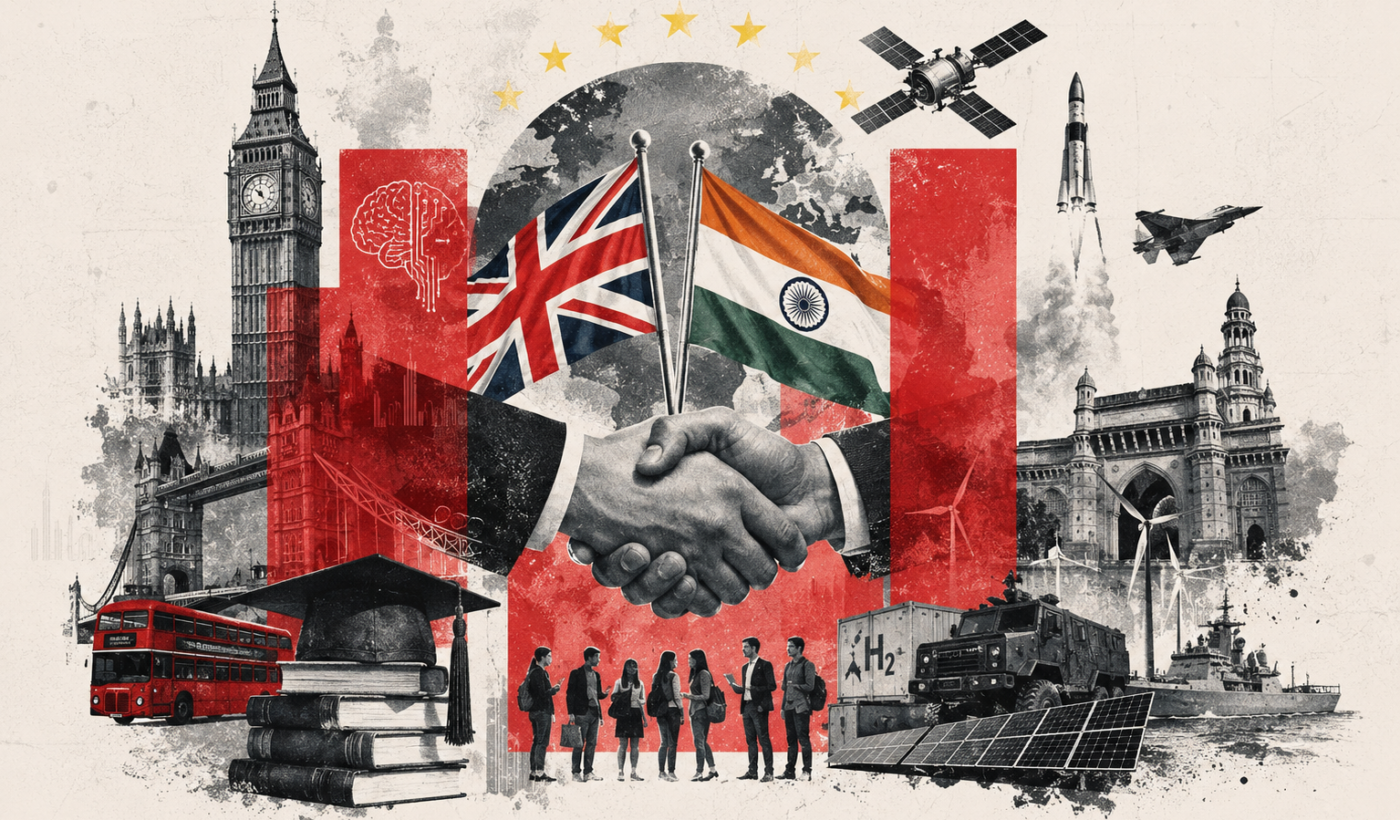
The UK–India relationship is no longer only about trade, migration or diaspora ties. Vision 2035 is an attempt to build a structured strategic architecture across growth, technology, defence, climate and education.
The phrase India–UK Vision 2035 sounds like the language of diplomacy. It is formal, future-facing and deliberately broad. But behind the phrase sits something more consequential: a deliberate attempt to move the India–UK relationship from episodic cooperation into a managed strategic system.
That distinction matters.
For decades, the relationship between London and New Delhi has been shaped by history, migration, education, professional services, trade and the Indian diaspora in Britain. Those links remain important, but they are no longer enough to explain the direction of the partnership. The newer relationship is being built around strategic dependencies: supply chains, technology standards, defence industrial cooperation, clean energy, financial connectivity, critical minerals, artificial intelligence, research, higher education and security in the Indo-Pacific.
The India–UK Vision 2035 was endorsed by the prime ministers of both countries in London on 24 July 2025. The official document says it is designed to set “clear strategic goals and milestones” for sustained collaboration and innovation by 2035, with pillars covering growth, technology and innovation, defence and security, climate and clean energy, and education.
The timing is not accidental. The world in which Britain and India are building this framework is more fragmented than the one that existed a decade ago. Supply chains are being politicised. Technology is being securitised. The Indo-Pacific is more contested. Climate finance is now a geopolitical issue. Skills, research and talent mobility have become tools of national power. In that environment, Vision 2035 is not only a bilateral roadmap. It is a way for both countries to reduce uncertainty by building structured habits of cooperation.
Vision 2035 is bigger than the trade deal
The India–UK trade deal is the most visible part of the relationship, but Vision 2035 is designed to sit above it. The official framework says the signing of the India–UK Comprehensive Economic and Trade Agreement, known as CETA, and the agreement to negotiate a Double Contribution Convention are milestones in bilateral relations. It also states that both sides are committed to working towards early conclusion of a Bilateral Investment Treaty.
This matters because trade agreements can open doors, but they do not automatically create strategic alignment. Tariff cuts help exporters. Business mobility rules help professionals. Procurement access helps firms. But a serious economic partnership needs continuing mechanisms: financial dialogues, investment channels, regulatory cooperation, business forums and systems for resolving friction before it becomes political.
Vision 2035 creates that wider architecture. It refers to a refreshed Joint Economic and Trade Committee to help drive the trade and investment relationship, while the Economic and Financial Dialogue and Financial Markets Dialogue are identified as platforms for macroeconomic policy, financial regulation and investment cooperation.
This is where the relationship becomes more serious. Britain is a financial, legal and services power. India is a scale market with expanding infrastructure, technology demand and global manufacturing ambition. The logic of Vision 2035 is to connect those strengths in a more systematic way.
The framework also identifies capital markets, insurance, pensions, asset management, AI in financial services, green finance and infrastructure investment as areas of cooperation. It specifically refers to the India–UK Financial Partnership and the UK–India Infrastructure Financing Bridge as mechanisms to strengthen business flows and unlock infrastructure investment in India.
In practical terms, this means the next phase of UK–India economic relations may be less about a single headline agreement and more about the machinery that follows. The trade deal may open the corridor. Vision 2035 is meant to organise the traffic.
Technology is the strategic centre of gravity
If trade is the public face of Vision 2035, technology is its strategic centre.
The official document says the UK and India will deepen collaboration in critical and emerging technologies, health and clean energy, building on the Technology Security Initiative, the Science and Innovation Council, and the Health and Lifesciences partnership. It identifies the UK–India Research & Innovation Corridor, a joint centre for AI, advanced connectivity, cyber resilience, critical minerals, biotechnology, semiconductors, quantum, advanced materials, cyber security and space collaboration as areas of work.
This is not a random list of fashionable sectors. It is a map of where future economic and security power is likely to sit.
Artificial intelligence will shape productivity, defence, healthcare, finance and public administration. Semiconductors and advanced materials are now treated as strategic inputs, not ordinary industrial components. Critical minerals determine whether clean energy, electric mobility and advanced manufacturing can scale. Cyber resilience affects public confidence, economic continuity and national security. Advanced telecommunications will shape digital inclusion and sovereign control over future networks.
Vision 2035 recognises that both countries bring different strengths. Britain has deep research institutions, cyber expertise, financial markets, regulatory credibility and advanced technology firms. India has scale, engineering talent, digital public infrastructure, a large start-up ecosystem and growing geopolitical weight. The partnership becomes meaningful if these assets are connected into usable programmes rather than left as diplomatic language.
The UK government’s trade and investment campaign also frames the Technology Security Initiative as a first-of-its-kind agreement between government, industry and academia, focused on critical and emerging technologies such as AI, quantum computing and semiconductors. It notes that both sides have welcomed new partnerships in telecoms, critical minerals, advanced materials and AI.
For The Prudent UK, the intelligence reading is clear. The UK–India technology relationship is not simply about innovation. It is about strategic dependence. Both countries are trying to build trusted supply chains, trusted standards, trusted research pathways and trusted talent systems in a world where technology is increasingly shaped by geopolitical blocs.
Defence and security give the partnership hard edges
For many years, the India–UK relationship was often discussed through trade, migration and education. Vision 2035 gives the partnership harder strategic edges.
The defence and security pillar includes a 10-year Defence Industrial Roadmap, senior-level mechanisms to monitor implementation, cooperation in advanced technologies and complex weapons, and programmes such as the Electric Propulsion Capability Partnership and Jet Engine Advanced Core Technologies. It also commits both sides to upgrading the existing Foreign and Defence 2+2 senior official dialogue and strengthening maritime cooperation under the Indo-Pacific Oceans’ Initiative.
This is a serious shift. Defence cooperation is no longer limited to exercises and ceremonial engagement. The language of the roadmap points toward co-development, industrial collaboration, sustainment, advanced capability and regional maritime security.
The document also identifies India as a regional hub for sustainment of logistics support to the UK armed forces presence in the Indian Ocean Region, while referring to joint exercises, training opportunities across all three services and military instructors in each other’s institutions.
That reflects a wider geopolitical reality. The Indian Ocean is no longer peripheral to British security thinking. It is central to energy flows, trade routes, submarine activity, supply chains and strategic competition. For India, deeper defence cooperation with the UK sits within a larger effort to diversify partnerships while retaining strategic autonomy. For Britain, India offers scale, geography and operational relevance in a region where the UK cannot act alone.
The security pillar also includes counter-terrorism, cyber security, transnational organised crime, illicit financial flows and irregular migration. Both countries commit to cooperation on terrorism, cybercrime, justice and law enforcement, as well as protection of citizens and key services from cyber threats.
This is where Vision 2035 becomes more than a positive-growth document. It is also a risk-management framework. The partnership is being designed not only to produce opportunity, but to manage instability.
Climate, clean energy and education complete the system
The climate and clean energy pillar is not separate from the economic strategy. It is part of it.
Vision 2035 says the partnership will support both countries’ net-zero goals, increase green manufacturing, mobilise climate finance and deepen collaboration on energy storage, grid transformation, offshore wind, carbon credits, civil nuclear cooperation, small modular reactors, clean transport, hydrogen, batteries, carbon capture and climate resilience.
This matters because India’s growth will require vast energy expansion, while Britain wants to position itself as a partner in green finance, grid expertise, offshore wind, nuclear services, climate technology and deep-tech innovation. The climate pillar is therefore not only about emissions. It is about markets, finance, resilience and industrial positioning.
The education pillar is equally strategic. Vision 2035 calls for an Annual Ministerial India–UK Education Dialogue, deeper higher-education partnerships, international branch campuses, transnational education, joint and dual degrees, a Green Skills Partnership, mutual recognition of qualifications, the Young Professionals Scheme and the Study India Programme.
This is the human-capital layer of the architecture.
If trade connects markets, technology connects innovation, defence connects security and climate connects infrastructure, then education connects the people who will operate the system. Skills, research, student mobility and institutional trust are not soft additions. They are the base through which long-term strategic relationships become durable.
The British Council has also described education as one of the flagship pillars of Vision 2035, noting that UK education builds trust, strengthens systems and creates lasting connections between people and nations.
That is not sentimental. It is accurate. The India–UK relationship has long been strengthened by students, professionals, families and institutional familiarity. Vision 2035 attempts to formalise that social infrastructure into a strategic asset.
The June 2026 review shows the system is now active
A roadmap matters only if it is reviewed and used. That is why the June 2026 visit of UK Foreign Secretary Yvette Cooper to India is significant.
The UK government said Cooper would meet External Affairs Minister Dr S. Jaishankar to review delivery under Vision 2035, with priorities for the year ahead across economic growth, technology and innovation, defence and security, climate and education. The announcement also said the partnership with India had reached new heights since Prime Minister Narendra Modi and Prime Minister Keir Starmer unveiled their strategic direction for deeper cooperation.
India’s Ministry of External Affairs similarly described the June 2026 visit as an opportunity to review India–UK Vision 2035 under all five pillars: Growth, Technology and Innovation, Defence and Security, Climate and Clean Energy, and Education.
This is important because Vision 2035 includes annual review by India’s External Affairs Minister and the UK Foreign Secretary. The framework also says sustained high-level political engagement and regular prime ministerial meetings will provide strategic direction and oversight.
That review mechanism is what separates a real strategic system from a decorative joint statement. It creates accountability. It forces both sides to measure progress. It gives officials a structure through which to escalate problems, align priorities and maintain momentum after the announcement fades.
Prime Minister Narendra Modi also affirmed during Cooper’s June 2026 visit that Vision 2035 would continue to guide the partnership and strengthen joint efforts for global good.
For diplomats, this language is familiar. For analysts, the structure is more important than the wording. A bilateral relationship that is reviewed annually, linked to trade implementation, tied to technology initiatives and extended into defence, climate and education has moved into a different category.
The Prudent assessment
The India–UK Vision 2035 framework should not be read as a single agreement. It is better understood as an operating system for the next decade of bilateral relations.
Its value lies in integration. Trade is linked to investment. Investment is linked to financial services. Technology is linked to security. Security is linked to the Indo-Pacific. Climate is linked to finance and infrastructure. Education is linked to talent, research and social trust.
That is the strategic architecture.
The opportunity is substantial. India gains a deeper partnership with a services, finance, education, research and defence-capability power. Britain gains a structured route into one of the most important growth markets of the century and a stronger partnership in the Indo-Pacific. Both countries gain a framework for reducing vulnerability in a world of disrupted supply chains, contested technology and unstable geopolitical alignments.
But the risks are equally clear. Vision 2035 is broad. Broad frameworks can lose force if everything becomes a priority. The partnership will need discipline: measurable milestones, sector-specific delivery, honest annual reviews, real business participation and political continuity on both sides.
The India–UK relationship is now too important to be managed by nostalgia or symbolism. It requires machinery.
Vision 2035 is that machinery. Its success will not be judged by the elegance of its language, but by whether it turns cooperation into capacity: more resilient trade, deeper technology links, credible defence collaboration, deployable climate finance and a generation of students, researchers and professionals who can carry the partnership beyond the cycle of political visits.
The intelligent conclusion is this: Vision 2035 is not merely about where India and the UK want to be in ten years. It is about whether both countries can build a disciplined enough system to get there.
Fetaured image in same style